
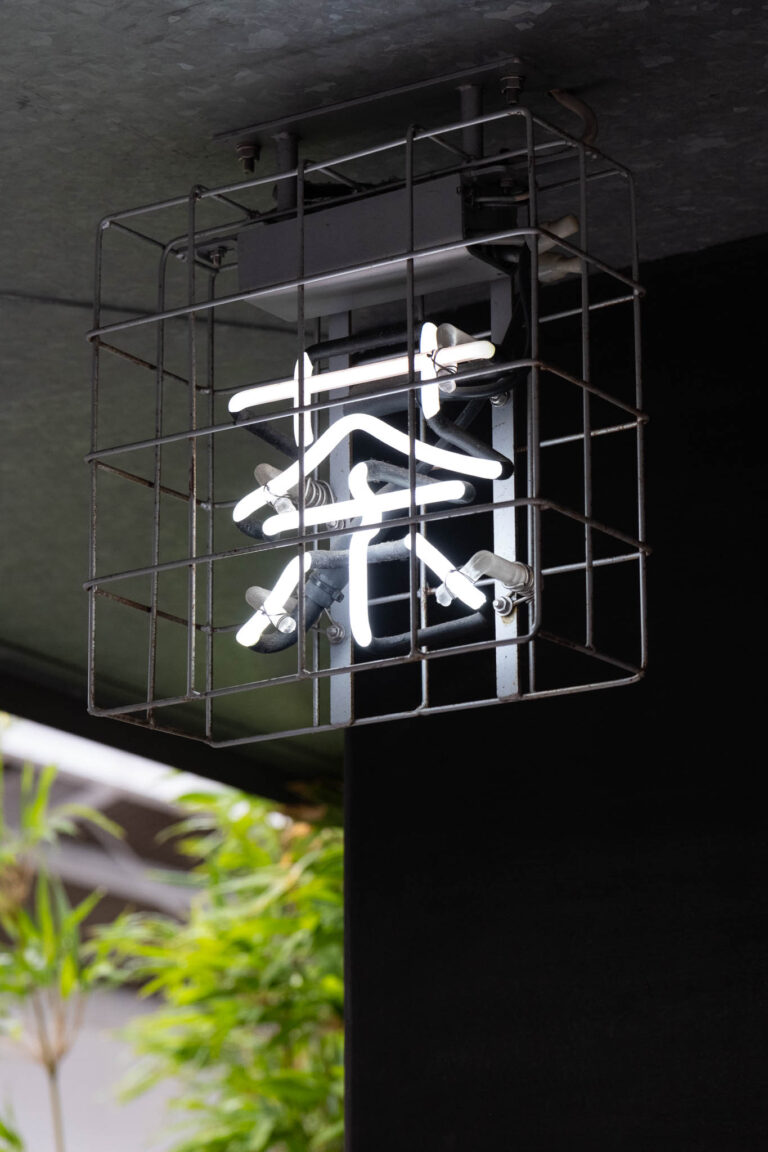
When I started this tea journey, my brewing skills and knowledge weren’t as sharp as those of other professionals. So instead of continuing to learn from books in France, I went back to Japan to observe the people who inspired me and Kenji Nakano was one of them. Even before meeting him, I have heard how brilliant he was. Here is my interview with him, on his vision of tea.
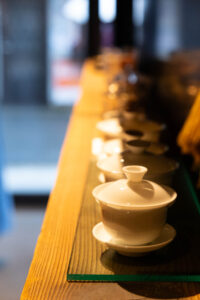
Set in a small street of Kyoto, I was very happy to finally meet him in person to finish my interview. The shop was beautifully designed in terms of layout, and it welcomed people directly to try the teas. I stayed there for two hours and could see how much people enjoy talking about tea, it really brings people together without boundaries. There is always a tea advisor on hand to help explain things.
One of the particularities of 7tea+ is that it doesn’t only source Japanese tea, but also Chinese, Indonesian, Vietnamese tea etc … I was pleasantly surprised to meet someone so open-minded and thoughtful beyond just tea itself. The experience he offers is very different from any shop I’ve seen in Europe. By covering seven categories, it becomes more accessible and doesn’t cater only to purists. I can assure you that the quality of his teas is exceptional as well.
My children and I came back again for a matcha and I have been able to try their exclusive matcha. Since I am passionate about matcha I found it very balanced and smooth, a very deserved drink afternoon in Kyoto.
Here are his answers to my questions for the European customers adding to some of my thinking for you to form your own opinions. With tea, my idea has always been to bring people together beyond borders with the precision and etiquette that Japan offers, but in a more accessible way.
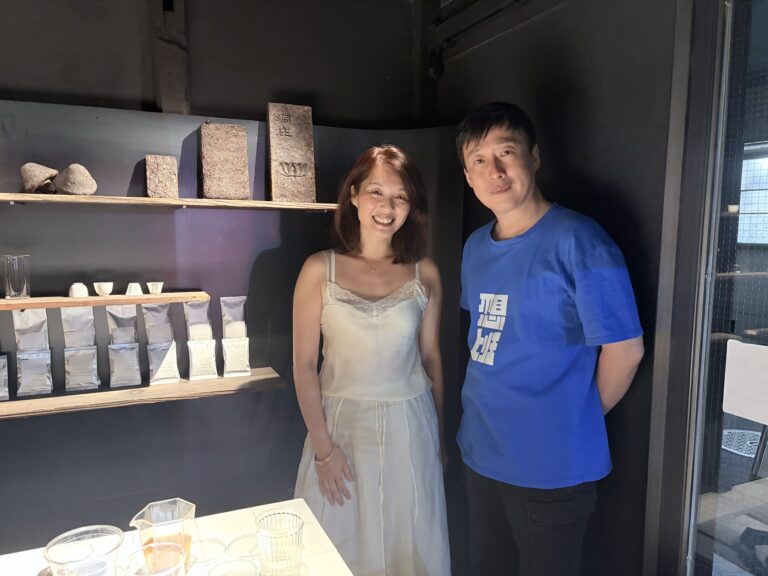
ORIGINS : Who is Nakano-san?
1. Where are you from, and what did you study at university?
Kenji : I was born in Osaka. People often think I am Chinese, but I am Japanese. When I was 14, I moved to Tokyo. The culture from western to eastern Japan is a little different. I think experiencing both sides gave me a wider sense of feeling and perspective. At university, I studied French. But I left university after two years, so I cannot say that my French is very good.
Christine : Despite speaking Japanese, Mandarin, and a bit of French and English, he remains remarkably humble.
2. You studied French. What brought you to France, and how long did you live there?
Kenji : At that time in Japan, many people admired the US when they thought about going abroad. But I have always felt value in choosing something a little different from other people. I was drawn to European culture, which felt very different from the US. For me, France seemed to be at the center of that world. The atmosphere of university in Japan did not really suit me, so after leaving school, I went to France, almost by momentum. I returned to Japan at times, but altogether I spent about two years there. I mainly stayed in Aix-en-Provence in the south of France, and I also traveled around Europe by train. I have only good memories from that time.
Christine : Now he stays in Kyoto and travels through Asia and beyond to source tea. He told me that Asia suits him very well.
3. What did France teach you about Japan that Japan itself never could?
Kenji : When I looked at Japan from the outside, it seemed a little different from the Japan I had seen from the inside, both in good ways and in difficult ways. I learned that truth is not always just one thing. It changes depending on where you stand, and which part of it you choose to look at. Living abroad also taught me how grateful I should be to my parents.
Christine : Identity shouldn’t be defined as one fixed thing, but as many things shaped by a lifetime of experiences. I think Kenji Katano captures this well as his teas show that diversity and knowledge can coexist. His vision of tea, to me, is brilliant.
THE PATH : From clay to tea
4. You spent a few years working with clay, first as an apprentice potter and then as a potter in your own right. What did that teach you that you still carry today?
Kenji : I learned the value of continuing, even if the steps are slow. I learned how important it is not to stop until I can truly feel satisfied with my own work.
Christine : What I appreciate most in Japanese culture is this ability to be consistent, and to perfect skills.
5. Then came a Chinese restaurant in Kyoto. How does one go from pottery to restaurant to tea?
Kenji : At that time, I did not clearly know what I really wanted to do. But I had a fairly clear sense of what I did not want to do. At each moment, I simply tried my best with whatever appeared in front of me, as long as I felt, “Maybe I would like to try this.” Before I knew it, my path had become what it is today. Pottery, the restaurant, and tea may not seem directly connected on the surface. But inside me, I feel they are connected at the root.
Christine : Having various skills requires the ability to adapt easily, and I think what makes that shop special is the variety and accessibility of its teas to everyone.
6. What was the turning point, the precise moment when tea became a vocation?
It was when I was creating the 7T+ shop. While preparing to open the store, I slowly narrowed down a concept that had been quite vague until then, and gave it a more concrete shape. When the shop was finally completed and the product list was ready, I naturally felt, “This is the path.” At the same time, I felt a kind of determination. I still remember that period very clearly.
7T+ The concept

7. Why Kyoto, and why the name “7T+” with its seven families of tea?
In terms of production volume alone, Kyoto is not the largest tea-producing region in Japan. However, many of the methods behind what we now call “Japanese tea,” such as sencha and gyokuro, are deeply connected to Kyoto. When we think about the history of tea spreading in Japan through Zen, and the influence of the tea ceremony, I believe Kyoto can be called one of the centre of Japanese tea culture. Many famous tea brands in the world were born not in tea-producing countries, but in tea-consuming countries. So I began to wonder : if we created a new tea brand from Japan, a country that actually produces tea, what kind of adventure could begin? That question was our starting point. And I felt that this journey should begin in Kyoto. The “7” stands for seven categories, and the “T” stands for Tea.
We based our system on the six major types of tea described by Chinese tea scholars, and then added tea-like drinks and reprocessed teas to create seven categories. Around the world, there are many drinks called “tea” even though they do not contain tea leaves. Mate, rooibos, and barley tea are examples. I believe this gives tea culture great depth. Because we want to broaden and raise the value of tea, we had no hesitation in making these drinks our seventh category. We also wanted to explore new ways of using tea, not only for drinking, but also in food, skincare, and other forms. That is why we added the “+”. We thought a lot about the name. For us, it is not only about selling and handing over a product. We want to deliver the feeling and story behind it. That is why we cared about choosing a name that anyone in the world could read, and one that expressed our way of thinking.
Christine : It can be confusing to think there are seven categories, but once you go through them, you’ll see you can choose whatever suits you best. For a multilingual person like me, it makes total sense to read through them and it even makes me more curious about teas I’ve probably never heard of.
8. At 7T+, you categorise tea by oxidation and character rather than origin or price. Can you walk us through your seven categories and why this system matters to you?
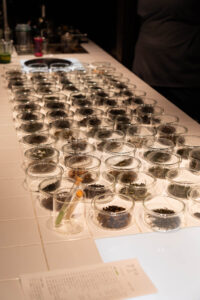
Some people say there are more than 3,000 types of tea in the world. Others say there are more than 5,000. In other words, tea is so diverse that it is difficult to count accurately. Just as bookstores and wine shops organize things by genre, I thought dividing tea into seven categories would help people understand tea in a more systematic way. It also helps customers choose tea more easily. I do not want tea to be only for a small group of enthusiasts. If more people are to enjoy tea, we need a clear and simple way to communicate it.
9. You refuse to judge a tea by its origin or its price. What led you to this position?
When you drink many different teas, you sometimes encounter moments when a famous name or a high price means almost nothing. Tea, if there is no one to enjoy it, could simply be seen as dried leaves. I believe it is not the shop that gives tea its true value, but the person who drinks it and enjoys it. A good tea changes depending on the time, the place, the occasion, and the person drinking it. That is why I feel that choosing tea with too many preconceptions can cloud our senses. I also believe that my approach to tea differs somewhat from conventional ones. To the extent that there is anything distinctive about it, this may be the result of the broader perspective I developed through several years spent in France and nearly twenty years of working closely with Chinese people.
I believe my sensibility and outlook were shaped mainly in Japan. It is true that Japanese society is generally regarded as placing great importance on discipline and conformity, and in some respects, I think that is accurate. However, throughout the history of this island nation, there have always been people who have challenged established conventions and commonly accepted ideas. The invention of karaoke, the Walkman and the QR code, as well as the fact that Japan has produced more Nobel Prize laureates than any other country in Asia, may be expressions of that spirit. Of course, I have yet to accomplish anything that could be compared with achievements of that magnitude. Nevertheless, in spirit, I feel that I stand on the side of those who question established forms and seek to create something new.
Christine: I tried the fermented tea at his shop, and it was a fairly acidic tea that my palate wasn’t used to yet. I went home and tried it again, and it had a very interesting taste. I asked what pairings might work, and cheesecake came up, along with cooking it with rice. I can see why fermented tea can, and should, be pushed further. In this context, tea has travelled quite a lot from China to Japan and since both cultures are strongly linked, 7tea+ brings many cultures together and makes customers enjoy tea for what it is, its own taste, rather than for its origin. I love it.
Sourcing tea
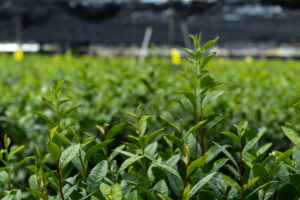
10. What does a sourcing trip look like? What are you looking for when you meet a producer?
I love sourcing trips so much that I could almost say I work in order to take them.
Where there is good tea, there is often a beautiful culture and delicious food. These things give me joy in life.
I believe that for any tea practitioner the ultimate goal is to meet farmer and understand their work then enlighten customers about techniques et vision. Meeting the producer brings me a lot of joy even more when I can see dedication.
When I meet producers, I try to be as open and honest as possible. I believe I can build good relationships with people who share the same sincere and open attitude.
11. Japanese tea and Chinese tea under the same roof, do these two cultures speak to each other, or are they fundamentally different?
Kenji : Japanese tea first started from a position where it was something expensive, enjoyed by certain privileged classes. Chinese tea, on the other hand, has long been more deeply rooted in everyday life. In that sense, there are real cultural differences between them. But from now on, I think these cultures will mix more and more, and the borders between them will become softer. I often talk about this with customers. For example, if sencha is made in Vietnam, is it Japanese tea, or is it Vietnamese tea? Today, oolong tea is made in Japan, and Japanese-style matcha is made in China. When we think about this, classifying tea only by place of production will slowly become less meaningful. I feel that tea may cross borders before humans do.
Christine : That is what interests me the most in this interview: can tea cross borders? There’s a new wave of Japanese baristas and tea practitioners going to Europe and the US to spread their culture and vision which is freer, wider, in a more casual setting. Am I correct ?
DISCOVERY
12. Is there a tea that has recently surprised you, one that almost nobody knows yet?
Last year, I visited Shikoku again and traveled to the production areas of Awa Bancha, Ishizuchi Kurocha, and Goishicha. These are Japanese post-fermented teas made with lactic acid fermentation. It is said that these teas may have roots in the teas of ethnic minority groups around Yunnan, Laos, and Myanmar. I am very interested in how such teas crossed the sea to Japan, and why they remain mainly in Shikoku.
13. What are the biggest challenges facing the Japanese tea industry today?
How can professionals like you help move it in a more sustainable direction?
What would you say to a European audience who is just discovering Japanese tea?
After World War II, Japanese tea seems to have moved toward efficiency and mass production. In that process, many teas became more uniform. I feel that many of them may have lost part of their original character. But recently, Japanese tea has slowly begun to recover its individuality. More producers are now trying to make fermented teas such as oolong and black tea. Just as Japanese whisky became recognized around the world by expressing the Japanese climate and Japanese sensibility, I believe Japanese fermented tea may one day find its own special place. Behind the recent matcha boom, there are producers who are quietly searching for the future of Japanese tea and working very hard. Regarding Japanese fermented tea, Japan’s relatively cool climate is not naturally ideal for its production. Simply applying the same methods used in China or Sri Lanka does not necessarily produce the best results.
However, Japanese producers are attempting to overcome these limitations through their characteristic ingenuity and meticulous attention to detail. I hope you will look forward to the emergence of fermented teas with a distinctly Japanese delicacy, purity and clarity.
I believe it is one of our missions to shine a light on them. There are also many local teas across Japan that are still not well known. I would be very happy if people in Europe also turned their attention to these teas. Through them, they may encounter something like the simple, original landscape of Japan.
The unexpected question
14. What is the question a customer never asks you, but that you wish someone would?
This may be a little outside the question, but customers from Japan and abroad often ask me what kind of food or sweets go well with a certain tea. But I would actually love to hear the opposite from them. I would love them to tell me, “When I drank this tea in my hometown, it surprisingly went well with this sweet,” or “It was really good with this local dish.”
Finally, it is certainly true that people’s palates differ from one region and culture to another. Yet, over time, Japanese people have learned to enjoy Vietnamese cuisine, while French people have come to eat ramen and appreciate its appeal. Wine and coffee are now loved throughout the world. I believe tea may be the next thing whose value is rediscovered on a global scale.
Tea is surely more than something we enjoy simply for its flavour. It is also a means of communication that brings people together, is it not?
As advances in AI and technology allow people to become freer and perhaps give them more time than before, could tea not become an ideal companion for humanity?
The ability to share it with others is another of tea’s great attractions.
That said, for tea to gain wider recognition and become a truly universal presence, I believe further effort will be required from all of us.
Let us continue moving towards that goal together.
As for questions, people often ask me about tea, and of course I am happy about that. But sometimes, I would also be very happy if they showed interest in me as a person. In that sense, Christine’s questions gave me a lot of energy. Thank you very much.
Conclusion

One thing that really struck me after two weeks in Kyoto, meeting people across the tea industry and especially Kenji Nakano, is this : can tea be enjoyed the way wine is with pairings and gatherings as central to the culture as wine is in Europe? As alcohol becomes less popular, tea could be elevated to that same level. It follows the same precision and technique, rooted in the same culture, agriculture, and tradition. What do you think?
The aim of this article is to shed light on people who want tea culture to evolve from Japan into Europe. We tend to lean on marketing to sell products steeped in tradition, and somewhere along the way we forget how those traditions were passed down to tea practitioners to evolve into our modern society, and into different cultures.

Store Information
Address: 73-1 Shioyacho, Ayakoji-dori, Tominokoji-higashiiru, Shimogyo-ku, Kyoto City
Phone: 075-708-7199
Opening hours: 11am-7pm
Closed on Thursdays

